


Apple's most recent update to its U.S. trade-in estimates, on 6 August 2026, pays up to $720 for an iPhone 16 Pro Max, up to $855 for a MacBook Pro, and up to $720 for an iPad Pro. It is the third increase of the year, after adjustments in March and May. That number is credit, not cash: it only applies to a new Apple purchase or an Apple Gift Card. Sell an iPhone 15 Pro Max to Back Market's buyback program instead and the top quote is $685, against Apple's $530 for the same model, paid directly to a bank account.
Short answer: check the tables below for what Apple currently pays for your exact model. If you want cash rather than Apple credit, or you are not buying anything new right away, a third-party buyback program usually pays a comparable or higher number and does not require an Apple purchase. If you are trading in to help pay for a new device, remember that the credit only covers part of the price: a new iPhone 17 starts at $799, and the $480 Apple pays for an iPhone 16 covers 60 percent of that at most.
Refurbished is the other side of this decision that a trade-in calculator never shows you. According to RefurbMe's own tracking, a new iPhone generation takes a median of about 82 days to reach the refurbished market after Apple's release (Time-to-Refurb, as of September 2026, source: /stats/iphone). That is the real cost of skipping trade-in and buying refurbished instead: a short wait, in exchange for a device that already costs less than trade-in credit alone would save you.
This guide covers what Apple is paying right now for iPhone, iPad and Mac, what changed across the three 2026 increases, how the credit-versus-cash math actually works, and how to keep your quoted value from dropping once Apple inspects the device.
Table of contents
- What Apple Trade In actually pays you
- Current Apple Trade In values (September 2026)
- What changed in 2026: three increases so far
- How the trade-in process actually works
- Apple Trade In vs selling to a buyback marketplace
- When trade-in wins and when selling wins
- The other half of the math: what a refurbished replacement actually costs
- How to prepare your device so the quoted value survives inspection
- FAQ
What Apple Trade In actually pays you
Apple Trade In is a device exchange program, not a marketplace. You answer a few condition questions, Apple gives you an estimated value, and that value is applied as credit toward a new Apple purchase, whether that is an iPhone, iPad, Mac or anything else Apple sells. If you are not buying anything at the time, Apple issues an Apple Gift Card by email instead, which you can use later.
Two things about that number matter before you rely on it. First, it is an estimate based on what you report online, not a locked offer. Apple confirms the final amount only after receiving and inspecting the device. Second, the credit is Apple-only. You cannot take a Trade In estimate and cash it out, and you cannot spend it at a third-party refurbisher. If you want money you can use anywhere, including on a refurbished device from a different seller, trading in through Apple is not the path: see our FAQ on trading in when buying refurbished for how that interacts with a refurbished purchase specifically.
Current Apple Trade In values (September 2026)
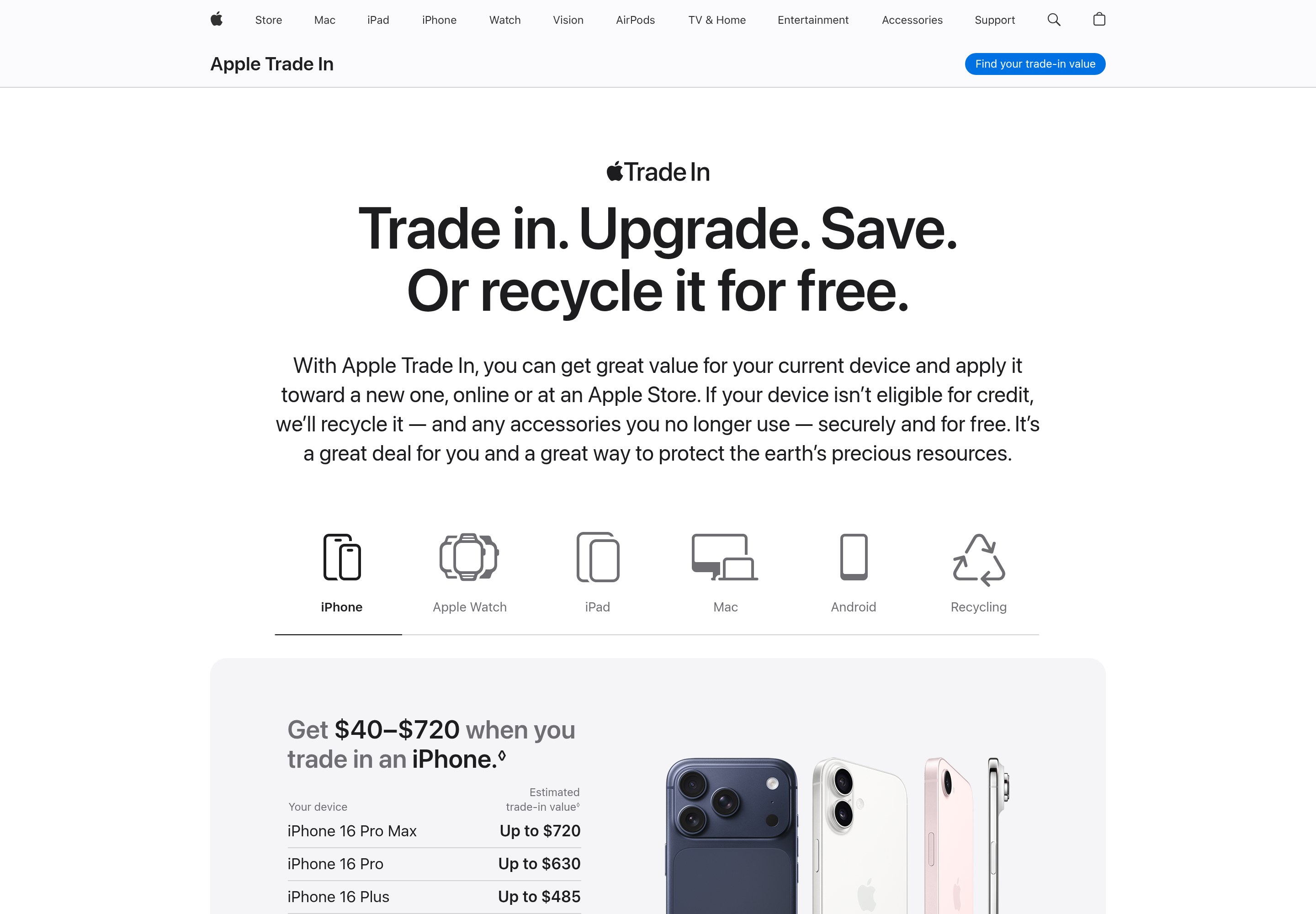
These are the maximum estimated values Apple is currently showing in the U.S. for a device in good condition with no cracks, no water damage and a battery that still holds a reasonable charge, confirmed against Apple's own trade-in page as of September 2026. A device with a cracked screen, a swollen battery, or a failed diagnostic test will quote lower, sometimes far lower, than the numbers below.
iPhone trade-in values
| Model | Max trade-in value |
|---|---|
| iPhone 16 Pro Max | $720 |
| iPhone 16 Pro | $630 |
| iPhone 16 Plus | $485 |
| iPhone 16 | $480 |
| iPhone 15 Pro Max | $530 |
| iPhone 15 Pro | $420 |
| iPhone 15 Plus | $340 |
| iPhone 15 | $335 |
| iPhone 14 Pro Max | $405 |
| iPhone 14 Pro | $335 |
| iPhone 14 | $235 |
| iPhone 13 Pro Max | $340 |
| iPhone 13 Pro | $285 |
| iPhone 13 | $205 |
iPad trade-in values
| Model | Max trade-in value |
|---|---|
| iPad Pro | $720 |
| iPad Air | $490 |
| iPad mini | $300 |
| iPad (base) | $260 |
Mac trade-in values
| Model | Max trade-in value |
|---|---|
| MacBook Pro | $855 |
| MacBook Air | $580 |
| Mac Studio | $1,305 |
| Mac Pro | $2,195 |
| Mac mini | $480 |
| iMac | $380 |
An iPhone 12 or older, an original iPad mini, or a pre-Apple Silicon Mac will still show a value, usually well under $150, but Apple's page lists dozens of legacy configurations we have not reproduced here. Check your exact model on Apple's Trade In page for a number specific to your storage size and carrier.
What changed in 2026: three increases so far
Apple has raised trade-in estimates three separate times in 2026: 2 March, 27 May, and 6 August. Not every change was an increase, and not every product line moved the same amount.
| Model | Before 2026 | 2 March | 27 May | 6 August |
|---|---|---|---|---|
| iPhone 16 Pro Max | $670 | $685 | $695 | $720 |
| iPad Pro | $685 | $670 | $690 | $720 |
| MacBook Air | $470 | $485 | $520 | $580 |
| MacBook Pro | $710 | $685 | $690 | $855 |
The iPhone line moved in small, steady steps all year, up about $35 to $70 total on most models. iPad was mixed: iPad Pro actually dropped $15 in March before recovering in May and August, while iPad Air and the base iPad rose in both March and May. Mac barely moved in March, MacBook Pro down $25 and MacBook Air up $15, and then climbed through May and August. The August increase was the largest of the three for Mac specifically: MacBook Pro rose 24 percent in one update, and Mac mini rose 28 percent, from $375 to $480.
The practical takeaway: if you checked your trade-in value earlier this year and decided it was not worth it, check again. An iPhone 16 that quoted $435 in April is quoting $480 today, and a MacBook Pro that quoted $690 in June is quoting $855 now.
How the trade-in process actually works
Online and in-store trade-ins follow slightly different paths, but both end with your old device gone and credit applied.
Online, through the Apple Store app or website:
- Start a new purchase and select "trade in" for the device you are buying against.
- Choose your old device's exact model and answer a short set of condition questions: screen condition, whether it powers on, battery health, and any prior repairs.
- Apple shows an estimated value immediately. Accept it and the credit applies at checkout.
- You have 14 days after receiving your new device to ship the old one back, using Apple's prepaid shipping label.
- Apple inspects the device on arrival. If it matches what you reported, the trade-in is final. If it does not, Apple sends a revised offer that you can accept or decline; declining gets the device shipped back to you.
In-store, at any Apple Store:
A specialist inspects the device on the spot rather than relying on your self-reported condition, so the in-store number is often more accurate on the first pass. You leave with credit applied to your purchase, or loaded onto a gift card if you are not buying that day.
Before sending in any device, back up your data and sign out of iCloud. Apple erases every device it receives, whether it goes toward resale or recycling.
Apple Trade In vs selling to a buyback marketplace
If your priority is money rather than a new Apple purchase, Apple Trade In is not really competing with itself, it is competing with a buyback marketplace. The two pay in fundamentally different ways.
Apple Trade In pays in credit toward an Apple purchase, or an Apple Gift Card if you are not buying anything right now. It is fast and requires no negotiation, but the payout is locked inside Apple's ecosystem.
A third-party buyback program pays cash. Back Market's trade-in service, for example, quotes an offer in minutes, covers return shipping, and pays out to a bank account, typically within about a week of the device arriving. As of this writing, Back Market lists up to $685 for a 1TB iPhone 15 Pro Max in top condition with little to no wear, roughly 29 percent above Apple's own $530 maximum for that model, and paid as cash you can spend anywhere, including on a refurbished replacement.
The difference that matters most: cash from a buyback sale is not tied to any specific next purchase. Apple credit is. If you plan to buy your next device refurbished rather than new, Apple Trade In's credit is close to useless to you, since it can only be spent at Apple. For a full breakdown of trade-in credit against buying refurbished as your next device, see our guide on Apple Trade In vs buying refurbished.
When trade-in wins and when selling wins
Neither option is universally better. It depends on what you are optimizing for.
Trade-in wins when:
- You are already buying a new Apple device and want the credit applied instantly at checkout.
- Your old device is recent and in strong condition, where Apple's estimate is closest to a competitive cash offer.
- You want Apple to handle data wiping, shipping and recycling end to end, with no separate sale to manage.
Selling wins when:
- You want cash, not Apple-only credit, especially if your next purchase will not be from Apple at all.
- Your device is a few generations old, where a buyback program's offer is more likely to beat Apple's.
- You plan to buy refurbished next, since cash from a sale can go toward any seller, while trade-in credit cannot.
The two are not mutually exclusive. You can sell or trade in the old device for whatever it is worth, then separately decide whether the next device is new, from Apple, or refurbished, from somewhere else entirely. And if the number on either side is not worth the hassle, keeping the device is a legitimate third option: our guide to repurposing an old iPad covers what an unwanted device is still good for.
The other half of the math: what a refurbished replacement actually costs
Every trade-in calculator answers one side of the question: what your old device is worth. None of them answer the other side: what your next device actually costs if you do not buy new.
RefurbMe tracks that gap directly. A new iPhone generation reaches the refurbished market a median of about 82 days after Apple's release, based on RefurbMe's Time-to-Refurb tracking as of September 2026 (source: /stats/iphone). Under three months from launch, a model already has a functioning refurbished market with multiple sellers competing on price.
Here is what that means in dollars today. A refurbished iPhone 16, the model at the top of Apple's current iPhone trade-in table, starts at $499 on Back Market, checked against RefurbMe's live listings. Trade in your old iPhone toward a new iPhone 17 and Apple's $480 maximum credit still leaves $319 to pay out of the $799 starting price. Sell that same old iPhone for cash instead and put the money toward a refurbished iPhone 16 at $499, and you are likely closer to covering the whole purchase.
Refurbished pricing moves with supply, so treat $499 as a snapshot rather than a fixed number, and compare it against RefurbMe's live iPhone listings or MacBook listings before deciding. The point stands either way: trade-in credit and buyback cash both cover only part of a new device's price, while the same money often buys a refurbished device outright. Apple sells its own certified refurbished stock too, at a smaller discount than third-party sellers; our breakdown of whether Apple's refurbished store is the best deal and 10 facts on whether Apple refurbished is worth it cover that trade-off in full.

128GB storage
Purple


How to prepare your device so the quoted value survives inspection
The single most common trade-in complaint is a quote that drops after Apple, or any buyback service, inspects the device. Most of that gap is avoidable.
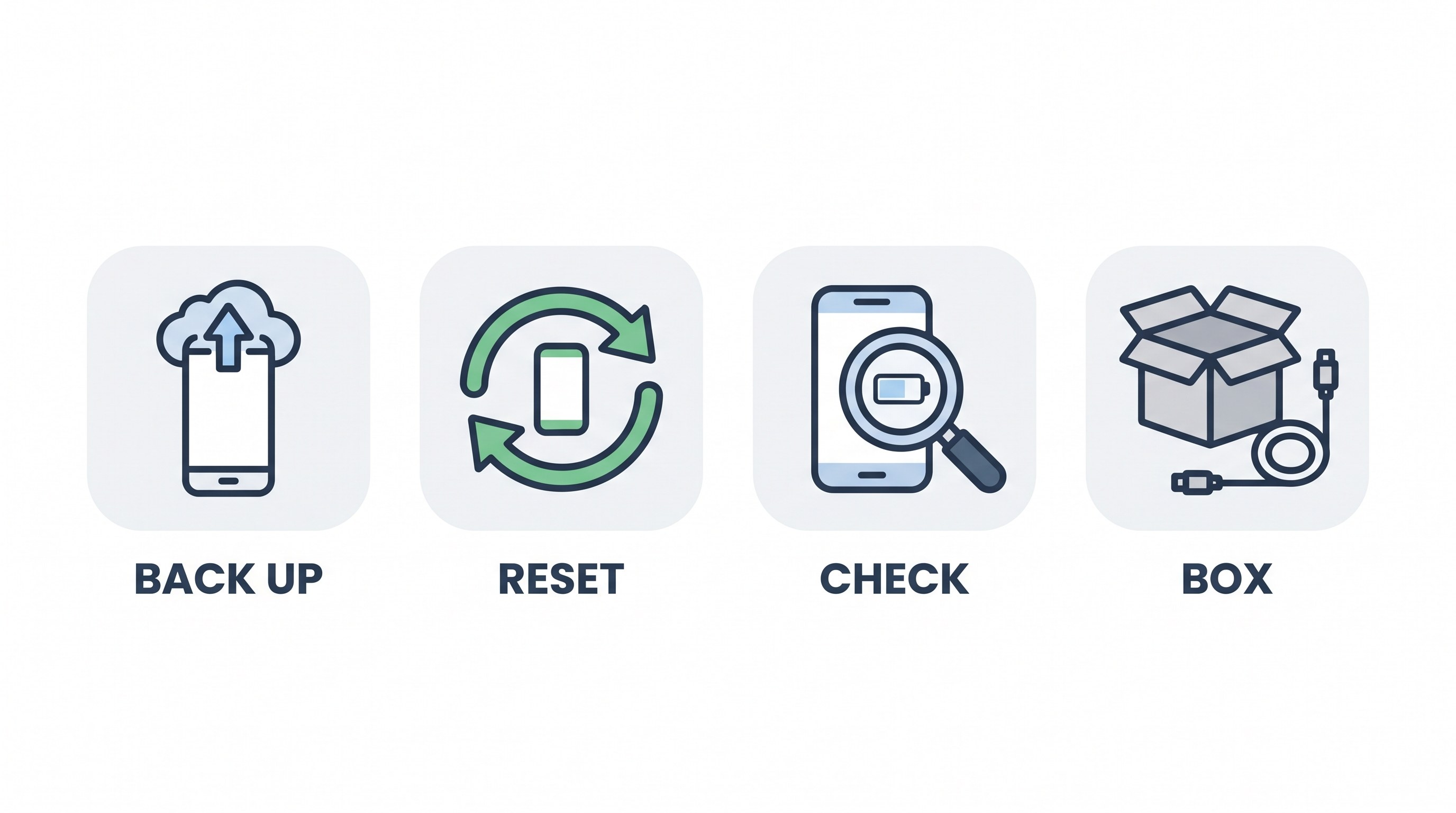
- Back up first, every time. Confirm your data is saved to iCloud or a computer before you touch any reset option. Apple can walk you through this during the online trade-in flow, but do it yourself first so nothing is lost if a step fails.
- Sign out of iCloud and Find My before resetting. A device still linked to your Apple ID through Activation Lock will be rejected outright, not just quoted lower. This is the single most common reason a trade-in gets refused rather than devalued.
- Answer the condition questions accurately, not optimistically. A hairline crack you describe as "no cracks" gets caught at inspection and revalues the offer downward, sometimes significantly. An accurate answer up front gets you the number you can actually expect.
- Check battery health. On iPhone, Settings, Battery, Battery Health shows your maximum capacity. A battery below 80 percent capacity can lower an offer even when the rest of the device is in excellent condition.
- Keep the original box and cable if you still have them. Not required for Apple Trade In, but several third-party buyback services quote a small premium for a complete kit, and it never hurts the offer.
FAQ
First published: Sep 4, 2026

