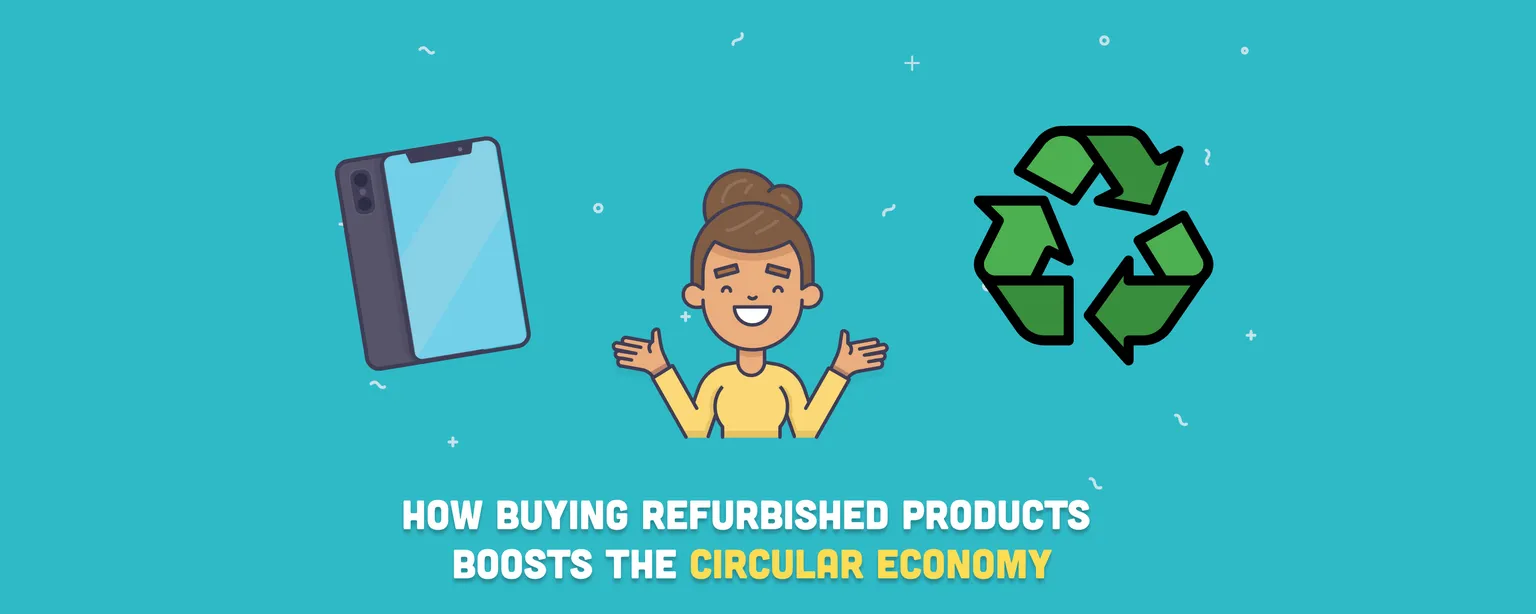
How Buying Refurbished Products Boosts the Circular Economy
The world generated 62 million tonnes of electronic waste in 2022, the latest year measured by the UN's Global E-Waste Monitor 2024, and only 22.3% was formally collected and recycled. That figure is projected to reach 82 million tonnes by 2030 while the documented recycling rate slips toward 20%. Meanwhile, the extraction of rare earth metals, cobalt, and lithium needed for new devices keeps accelerating.
Simo Elalj, CEO at RefurbMe Last updated · 8 min reading time
Buying refurbished is one of the most direct actions a consumer can take to interrupt that cycle. It keeps functional devices in use, reduces demand for virgin materials, and cuts carbon emissions at every stage of a product's life. The circular economy depends on exactly this kind of behavior: choosing reuse over disposal.
This article explains the environmental case for buying refurbished technology, with data on CO2 savings, e-waste reduction, energy efficiency, and what the refurbished market looks like today.
RefurbMe has tracked this reuse market since well before it went mainstream. Across every iPhone model it follows, a refurbished unit reappears on the market a median of 67 days after Apple announces the model (RefurbMe Time-to-Refurb, as of October 2026). That is direct evidence of the circular economy at work: functional devices re-enter circulation within months rather than sitting in a drawer or heading to a landfill.
What is the circular economy?
A circular economy is an economic model designed to eliminate waste by keeping products, components, and materials in use for as long as possible. It stands in contrast to the traditional linear model: make, use, discard.
In a circular model, a smartphone that would otherwise be scrapped is instead tested, repaired, and resold. The materials inside it, including gold, copper, lithium, and rare earth elements, do not end up in a landfill. The energy spent manufacturing it is not wasted.
Technology is one of the sectors where circular principles matter most, because electronics are resource-intensive to produce and short-lived in practice. Most users replace their smartphones approximately every two and a half years, as explored in our guide to how long a cell phone lasts. That short replacement cycle, multiplied across billions of devices, drives an enormous volume of waste.
New programs are emerging to address this. They include certified refurbishment networks, component-level repairability in newer devices, eco-smartphone initiatives, and the growing Right to Repair movement. Buying refurbished fits directly into this ecosystem and is one of the simplest steps any buyer can take.
CO2 emissions reduction: the numbers
Manufacturing a new smartphone generates roughly 70 kg of CO2-equivalent emissions, and around 80% of that footprint comes from production: mining raw materials, fabricating components, and assembling the final device. Only a small share comes from actually using the phone.
When you extend a device's life by buying a refurbished model, you avoid triggering that production footprint almost entirely. According to Green Alliance, using a mobile phone for one extra year cuts its lifetime CO2 impact by about a third. A lifecycle assessment by ADEME, the French environment agency, goes further: choosing a refurbished smartphone instead of a new one reduces its overall environmental impact by 77% to 91% depending on the indicator, and cuts its carbon footprint specifically by about 87%. The widely quoted "up to 91% lower" claim sits at the top of that ADEME range. In concrete terms, Back Market's ADEME-based lifecycle estimate puts a refurbished phone at roughly 7 kg of CO2-equivalent against about 85 kg for a new one over comparable use.
Smartphone footprint
New device
Refurbished device
Lifecycle CO2-equivalent
~85 kg
~7 kg
Share of footprint from manufacturing
~80%
largely avoided
Overall environmental impact vs new
baseline
77% to 91% lower
Carbon footprint vs new
baseline
~87% lower
Sources: ADEME lifecycle assessment of reconditioned smartphones (2022, via labo.societenumerique.gouv.fr); Back Market ADEME-based lifecycle estimate. Figures are per-device and vary by model and usage.
Refurbishing reduces demand for natural and valuable resources across the production chain. When fewer new devices are manufactured, less mining occurs, fewer factories run at full capacity, and fewer components travel long distances by air and sea.
A refurbished smartphone or tablet looks new and performs at full specification. Certified technicians test and repair pre-owned models thoroughly, replacing batteries, screens, and any components that do not meet performance standards. This is why platforms like RefurbMe only list products that come with a warranty: it removes the quality uncertainty that concerns some buyers.
Check these iPhones in excellent condition compared on RefurbMe. They perform identically to brand-new models from the official Apple Store.
from $94 carrier-lockedin Excellent Refurbished iPhone · 94 configurations at 6 sellers. Checked Oct 5, 12:05 PM EDT.
Raw materials are difficult and destructive to extract. Cobalt comes largely from the Democratic Republic of Congo, where mining conditions carry serious human and environmental costs. Lithium extraction in South America consumes vast quantities of fresh water in already water-stressed regions. When finished devices are discarded without recovery, all of those embedded costs are simply lost.
Global e-waste reached 62 million tonnes in 2022, the most recent year measured, and is rising about five times faster than documented recycling. On current trends it will hit 82 million tonnes by 2030. Europe's formal collection rate stands at about 43%, the highest of any region, yet it still leaves well over half of discarded electronics outside certified recycling streams. In the United States, the documented collection rate is far lower.
The problem compounds because electronics recycling is genuinely hard. Circuit boards contain dozens of materials in tiny quantities, and separating them requires specialized processes that are costly and energy-intensive. Even the best recycling facilities cannot recover all embedded value. Prevention, meaning extending device lifespans before they reach that stage, is more efficient.
When you choose a refurbished device, you actively reduce e-waste. You slow the manufacturing cycle, reduce the demand that drives new production, and keep a functional device out of a landfill for several more years. This is not a marginal benefit: it is the core mechanism through which the refurbished market supports circular economy goals.
Energy and fuel savings along the supply chain
Manufacturing electrical devices requires high energy consumption. Smelting aluminum, fabricating glass screens, producing lithium-ion cells, and running semiconductor fabrication plants are all energy-intensive processes. When global smartphone shipments run into the hundreds of millions of units per year, those processes add up to a significant share of industrial energy use.
Transportation adds another layer. Components for a single smartphone may cross dozens of borders before the final device reaches a retail shelf, traveling by ship, truck, and air freight. Air freight in particular is exceptionally carbon-intensive, by some logistics estimates up to roughly 50 times more so than ocean shipping per tonne-kilometer.
When you buy refurbished, the indirect costs are significantly lower. The device has already made that journey once. The resale supply chain is shorter: a certified refurbisher tests the device, performs any necessary repairs, and ships it directly to the buyer. Far fewer intermediaries, far fewer transport legs, and considerably less energy consumed.
This efficiency compounds the direct savings from avoided manufacturing. A refurbished device avoids both the production carbon cost and most of the logistics carbon cost, while delivering the same utility to the end user.
The refurbished market today
Market research puts the global refurbished and used smartphone market in the tens of billions of dollars in the mid-2020s, with most forecasts projecting high single-digit to low-teens annual growth through 2030. Consumer attitudes are shifting. Surveys consistently show that buyers increasingly prioritize value and sustainability, and refurbished devices now occupy a mainstream position in the market rather than a niche one.
Major platforms have responded. Back Market, Apple's own Certified Refurbished store, and Amazon Renewed all offer certified devices with warranties and return policies comparable to new product purchases. RefurbMe aggregates listings from these and other sellers in real time, so buyers can compare prices and conditions across the market in one place.
RefurbMe's own tracking shows how deep those savings can run. For the 12-inch MacBook family on its MacBook stats page, a refurbished unit first appears a median of 104 days after Apple announces a model, and the median discount is 87% below the original Apple price across every model in that family (RefurbMe Time-to-Refurb and Refurb Discount, as of October 2026). Those are all legacy models from 2015 to 2017, so the median runs deeper than the saving on a current MacBook: for a current model, a refurbished unit typically lands 20% to 50% below new. Either way, each of those purchases keeps a working device in circulation instead of the waste stream.
from $99in Fair Refurbished MacBook · 409 configurations at 5 sellers. Checked Oct 5, 12:41 PM EDT.
Understanding the differences between sellers matters. For a detailed comparison, see our guide to used vs. refurbished vs. new Apple devices. For a deeper look at the Apple program specifically, our article on Apple Certified Refurbished covers what the certification means and what protections it provides.
If you are weighing whether the quality holds up, our analysis of whether refurbished MacBooks are worth it covers the pros, cons, and real-world performance data in detail.
Not ready to buy?
Email me when a refurbished iPhone is listed under $80. You also get our weekly deals email. Unsubscribe anytime.
Summary: the circular economy case for refurbished tech
Buying refurbished technology delivers measurable environmental benefits at every stage of a product's life cycle:
Environmental footprint: up to 91% lower across indicators, and about 87% lower carbon specifically (ADEME), mainly by avoiding the production footprint
E-waste: extends device life by 2 to 4 years on average, reducing landfill contribution
Raw materials: reduces demand for cobalt, lithium, rare earth elements, and other mined inputs
Energy and transport: shorter supply chains mean lower fuel and electricity consumption per unit sold
Cost: refurbished devices typically cost 20 to 50% less than their new equivalents
The circular economy is not an abstract concept. It is the practical outcome of millions of individual decisions to reuse rather than replace. Every refurbished purchase supports that outcome directly.
Visit RefurbMe to find the best refurbished Apple devices available across all major sellers, compared in real time.
from $49in Fair Refurbished Apple Products · 997 configurations at 6 sellers. Checked Oct 5, 12:41 PM EDT.
What is the circular economy and how does buying refurbished support it?
The circular economy is an economic model that keeps products and materials in use for as long as possible, eliminating waste. Buying refurbished supports it directly by extending device lifespans, reducing demand for new production, and keeping materials out of landfills.
How much CO2 does buying refurbished save compared to buying new?
According to ADEME, choosing a refurbished device cuts its overall environmental footprint by up to 91% compared to buying new, and its carbon footprint specifically by about 87%. A new smartphone carries roughly 85 kg of CO2-equivalent over its life; a refurbished one carries around 7 kg.
How much e-waste does the world produce each year?
The world generated 62 million tonnes of electronic waste in 2022, according to the UN Global E-Waste Monitor 2024, the most recent year measured. Only 22.3% was formally collected and recycled, and the figure is expected to reach 82 million tonnes by 2030.
Is refurbished tech as good as new in terms of quality and performance?
Yes. Certified refurbished devices are tested and repaired by technicians to meet full performance standards. Batteries, screens, and components that do not pass inspection are replaced. Most certified programs also include a warranty, which is one of the criteria RefurbMe uses to select listed products.
Where can I buy refurbished Apple devices that support the circular economy?
Major certified sellers include the Apple Certified Refurbished store, Back Market, and Amazon Renewed. RefurbMe aggregates listings from these and other sellers in real time so you can compare prices and conditions in one place.
Last updated: Jul 16, 2026 ·
First published: Nov 9, 2023
Simo Elalj
CEO and Founder at RefurbMe. I made this project back when I was 15 when I had to wake up at 2am to buy my own refurbished Macbook Pro. Passionate about circular economy, great UX and goats.